Tracer library / [64Cu]Cu-FAPI-2286
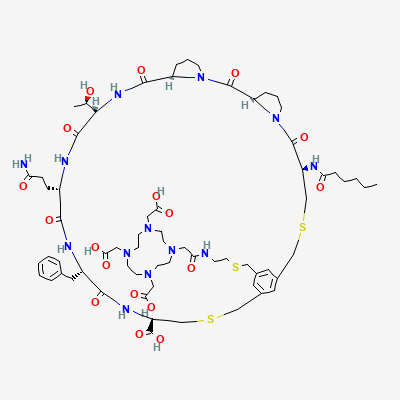
[64Cu]Cu-FAPI-2286
Also written as [64Cu]Cu-FAPI-2286; [Cu-64]Cu-FAPI-2286
- Radionuclide
- Cu-64 t½ 762 min
- Modality
- PET
- Production route
- —
- Stage
- Clinical research
- Syntheses indexed
- 1
What it is
- Compound class
- FAP inhibitor (FAPI) peptide-based radiotracer
- Target / mechanism
- Fibroblast Activation Protein (FAP) PMID 42425054
- Clinical application
- Liver fibrosis (hepatic stellate cell activity) in a patient with HCV-related decompensated cirrhosis PMID 42425054
- Theranostic pair
- [177Lu]Lu-FAPI-2286
Published syntheses
| Module | Cassette | Purification | Yield % | RCP % | Precursor / supplier | Source |
|---|---|---|---|---|---|---|
| — | — | — | — | >95% | FAPI-2286 | 42425054 2026 Nucl Med Biol |
Need this precursor?We can point you to suppliers for [64Cu]Cu-FAPI-2286, or handle the enquiry for you.
Get in touchQuality control Preliminary - inferred from compound class
- Ph. Eur. monograph
- not verified No Ph. Eur. check is recorded for this entry.
- USP monograph
- not verified No USP check is recorded for this entry.
How this set was arrived at. base set per Ph. Eur. general monograph 0125 (rule); radiometal tracer -> metal impurities (rule); receptor ligand with a saturable target -> molar activity (rule)
Tests listed by reference only. Monograph texts are copyrighted and are not reproduced here. How these are derived
Setting up quality control?We can help you scope the equipment needed to release [64Cu]Cu-FAPI-2286.
Get in touchNotes
Added from reverse module search (stage 6); 1 article(s) with Cu-64. Also seen with Cu-67[1], Ga-68[1], Lu-177[1] (too few articles for own row). Compound class inferred from precursor name (not stated outright) -- PMID 42425054: 'FAPI-2286'. Stage set/updated at stage 39 from PMID 42425054: 'initial clinical evaluation of [64Cu]Cu-FAPI-2286 in liver fibrosis'.